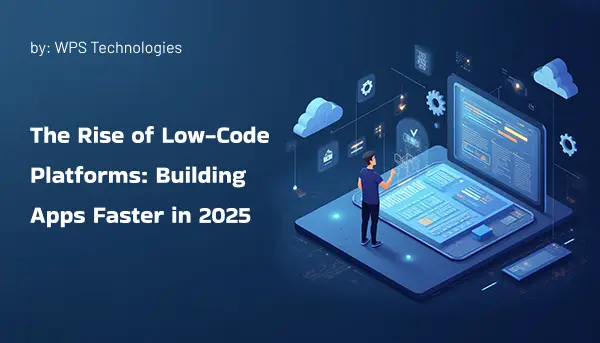
The Rise of Low-Code Platforms: Building Apps Faster in 2025
In today’s digital-first era, speed and innovation define business success. Traditional app development often takes months or even years, requiring large budgets and highly skilled developers. But in 2025, low-code platforms have become a game-changer. They enable businesses to deliver apps faster, improve agility, and stay ahead of competitors. From startups to large enterprises, everyone is leveraging low-code to build apps smarter and quicker.
What are Low-Code Platforms?
Low-code platforms are development environments that allow users to create applications using drag-and-drop interfaces, pre-built modules, and minimal coding. Unlike traditional coding, which requires deep programming expertise, low-code solutions empower both professional developers and non-technical employees to build powerful apps. This democratization of app development is one of the biggest shifts happening in 2025.
Why Low-Code Platforms Are Growing in 2025
1. Faster Development
Businesses in 2025 cannot afford delays. Low-code platforms reduce time-to-market dramatically, allowing apps to be built up to 70% faster than traditional methods. This helps companies respond quickly to customer needs and market changes.
2. Cost-Effective
Developing software traditionally requires large developer teams and months of work. Low-code platforms cut down on these costs by simplifying the process and reducing dependency on specialized coding skills. This makes them a highly cost-effective option for businesses of all sizes.
3. Empowering Citizen Developers
Low-code tools are enabling non-technical employees—often called citizen developers—to create apps that solve real business problems. This encourages innovation and collaboration within organizations, as more people can contribute to digital transformation.
4. Integration with AI & Automation
In 2025, low-code platforms are evolving with AI integrations and workflow automation. This makes it easier to create intelligent apps that not only perform tasks but also provide insights, predictions, and automated actions.
Benefits of Low-Code Platforms in 2025
- Rapid Prototyping → Businesses can test and launch ideas quickly without months of planning.
- Flexibility → Applications can easily adapt to evolving business requirements.
- Scalability → From small departmental apps to large enterprise systems, low-code platforms can handle it all.
- Improved Collaboration → Bridges the gap between IT teams and business users, allowing faster decision-making.
- Future-Readiness → Keeps businesses ready for digital innovation and technological shifts.
Popular Low-Code Platforms in 2025
- OutSystems – Known for enterprise-grade scalability and performance.
- Mendix – Focused on flexibility and multi-cloud deployment.
- Microsoft Power Apps – Ideal for organizations already using Microsoft 365 and Azure.
- Zoho Creator – Affordable and perfect for SMBs and startups.
- Appian – Strong in process automation and AI integration.
Future of Low-Code Development
According to Gartner, by 2025 more than 70% of new applications will be built on low-code or no-code platforms. This trend shows that low-code is not just a temporary solution but the future of app development. As AI and automation continue to evolve, low-code platforms will become even smarter, empowering businesses to create apps that are faster, more intelligent, and more cost-efficient.
Conclusion
Low-code platforms in 2025 deliver the perfect combination of speed, cost savings, flexibility, and innovation. They allow organizations to accelerate digital transformation while reducing dependency on traditional coding. For any business that wants to stay competitive in today’s fast-paced digital economy, adopting low-code is no longer an option—it’s a necessity.